HRDF · RiyadhLyzr AgenticOS · July 2026 · Confidential

Building the intelligent workforce engine.

A strategic perspective on AI-enabled transformation for HRDF — the Human Resources Development Fund of Saudi Arabia.

12.3% → 6.4%
Saudi unemployment at Vision 2030's launch → Q1 2026
562,000+
Citizens placed in FY2025
SR 8.29B
Invested in training in FY2025
Sources: GASTAT Labour Market Statistics · HRDF Annual Report 2025 · hrdf.org.sa
Prepared · July 2026 · by Lyzr · Confidential

HRDF has transformed Saudi Arabia's workforce landscape. The harder question is what comes next. The data to answer it already exists inside HRDF's systems.

HRDF built the right machine. Now the machine needs to think.

Saudi Arabia revised its unemployment target to 5% by 2030. That revision is not a celebration of what has been achieved — it is a harder problem. Volume and throughput got the Kingdom to 6.4%. The next 1.4 points require something different.

13.8% Youth male unemployment (ages 15–24)·20.4% Youth female unemployment (ages 15–24)·40% of Saudi CEOs cite skills gaps as their primary challenge·5% National unemployment target by 2030
Sources: GASTAT Q1 2026 Labour Force Survey (youth figures); PwC 28th Annual CEO Survey (skills gaps); Minister Al-Rajhi, Budget Forum 2024 (5% target)
The Established Mandate

The machinery that placed 562,000 citizens and cut unemployment to 6.4% was built for throughput. It delivered. That is not the 5% problem.

See the data+

562,000 Saudi citizens placed in private sector establishments in 2025. +29% year-on-year. 226,000+ establishments supported — 94% SMEs. SR 8.29B invested in training, benefiting 2M+ citizens. The throughput infrastructure works at extraordinary scale.

Source: HRDF official announcement, Arab News 5 February 2026 — Director General Turki Al-Jawini on record.
The Next Mandate

Youth unemployment sits at 13.8% for males and 20.4% for females ages 15–24 — more than double the national headline. 40% of Saudi CEOs name skills gaps as their primary challenge. The 5% target is a matching problem — not a volume one.

See the data+

Youth male unemployment: 13.8% (ages 15–24, Q1 2026). Youth female unemployment: 20.4% (ages 15–24, Q1 2026). National headline: 6.4% (Q1 2026). The gap is structural — not operational. Female workforce participation has more than doubled since Vision 2030's launch. 40% of Saudi CEOs cite skills gaps as their primary hiring challenge, particularly in technical and engineering fields.

GASTAT Q1 2026 Labour Force Survey; PwC 28th Annual CEO Survey; Minister Al-Rajhi, Budget Forum 2024

The 5% target is not a scale problem. It is a connection problem.

Three stakeholders. One untapped asset. The connection is what's missing — not the data.

Three stakeholders. One untapped asset. The same shift — unlocked.

Citizens, companies, and the country each experience the same structural gap: HRDF holds the data to serve them better — and it isn't connected to the decision yet.

Citizens · Supply Engine

From navigating eight programmes independently — to a platform that navigates for them

Jadarat, Doroob, Tamheer, Wusool, Qurrah — 2M+ beneficiaries, zero connected intelligence.

Two million citizens navigate eight disconnected programmes. No thread connects their skills to the right placement — before the mismatch becomes a dropout.

Read the full shift+

The shift is from a citizen navigating eight separate systems to a platform that navigates for them. Skills assessed at enrolment — not at dropout. Doroob recommendations built from training-to-employment conversion data — not catalogue browsing. Tamheer placements aligned to employer pipeline needs. Employment tracked at month 6, 12, and 24. Mismatch flagged before a role is accepted, not after a contract ends.

What happens when a citizen's Tamheer training performance automatically surfaces them to employers whose live Nitaqat gap matches their emerging skill set — before the job is posted on Jadarat?
Companies · Demand Creators

From reacting to Nitaqat announcements — to receiving intelligence 14 months in advance

562,000 placements in FY2025, +29% year-on-year. A significant share of establishments fall out of Nitaqat compliance each cycle.

A significant share of establishments enter Nitaqat non-compliance every cycle — detected after the window closes. The signal that would flag it earlier is in HRDF's own systems — a lead time to validate in the POC.

Read the full shift+

The shift is from reactive compliance to proactive partnership. HRDF identifies at-risk establishments ahead of their compliance window, not after. It surfaces pre-qualified Tamheer graduates completing relevant training before an employer posts on Jadarat. It validates subsidy eligibility at point of hire rather than via manual claim submission. It scores post-placement retention risk so employers build genuine Saudi careers, not Nitaqat headcount.

What if HRDF could tell a manufacturing company: "Engineering quota for your size band increases in 14 months — here are 31 qualified Tamheer graduates completing relevant placements now, in your region, at your salary range"?
Illustrative example — figures notional. Nitaqat 2026 thresholds: MHRSD decrees
Country · National Outcomes

From quarterly outcome reports — to a forward model of what the labour market will need

National Labour Observatory mandate: "thought leader in labour market insights" — hrdf.org.sa

HRDF reports what happened. The National Observatory mandate requires modelling what will. That shift cannot happen on annual reporting cycles.

Read the full shift+

The shift is from reporting outcomes to shaping them. HRDF models sector talent demand 12–18 months forward — before giga-project timelines create shortages. It attributes programme ROI per riyal in real time, so design changes happen this quarter, not next year. It simulates policy impact before MHRSD activates new thresholds. NDF receives an intelligence brief — which sectors will face shortfalls, which pipelines are already building to meet them — not a placement count.

What if HRDF's NDF brief didn't say "we placed 562,000 citizens" — but showed "we identified a healthcare talent gap 16 months in advance, pre-built a Tamheer pipeline in three regions, and achieved 84% sustained employment at month 12 in that cohort"?
Illustrative example — figures notional. National Labour Observatory: hrdf.org.sa

What the shift looks like — for each stakeholder

Citizens

Supply Engine
Today
Registers on Jadarat
Browses Doroob catalogue independently
Applies to Tamheer placement manually
Requests Wusool transport support
Searches for jobs independently
AI-enabled shift
Tomorrow
Skills assessed → matched to live Nitaqat sector demand
Doroob recommendation built from training-to-employment conversion data
Tamheer placement aligned to employer pipeline before role is posted
Dropout risk scored at enrolment — intervention triggered proactively
Employment tracked at month 6, 12, and 24 — not just at placement
Skills connect to sector demand before the job is posted.
Illustrative lead times — validated against HRDF data in the POC.

Companies

Demand Creators
Today
Checks Nitaqat band status
Submits wage subsidy claim manually
Posts role on Jadarat
Hosts Tamheer trainee
Reacts when new Saudisation quota announced
AI-enabled shift
Tomorrow
Nitaqat risk scored 60–90 days before compliance window closes
Sector quota change predicted 14 months in advance from MHRSD pattern data
Graduates from relevant Tamheer cohorts surfaced before role is posted
Subsidy eligibility auto-validated at point of hire
Sustained employment benchmarked against sector peers — not just placement confirmed
Quota intelligence arrives 14 months before the threshold changes.
Illustrative lead times — validated against HRDF data in the POC.

Country

National Outcomes
Today
Quarterly placement count reported to NDF
Programme spend tracked across eight programme families in arrears
Unemployment rate published by GASTAT quarterly
Saudisation progress measured retroactively
New Nitaqat thresholds announced — HRDF reacts
AI-enabled shift
Tomorrow
Sector talent demand modelled 12–18 months forward
Programme ROI attributed per riyal across all eight programme families, in real time
National AI Index score reflects AI actually in production
Policy impact simulated before MHRSD activation
NDF receives forward intelligence brief — not a placement count
NDF receives a forecast — not a placement count.
Illustrative lead times — validated against HRDF data in the POC.

The data already flows through HRDF's systems. Lyzr puts it to work.

The connection HRDF needs. Two engines. One platform. Already in the data.

Lyzr doesn't bring new data to HRDF. It connects what HRDF already holds to the decisions that data should be driving.

Engine 01 · Processing

Make every operation smarter. Before problems surface, not after.

Compliance foresight · Training feedback · Disbursement processing

Nitaqat risk flagged well before the window closes. Training spend aligned to this quarter's market demand — not last year's. The data for both already flows through HRDF's systems. Lyzr puts it to work.

See what this closes+
Nitaqat risk flagged ahead of the compliance window (lead time validated in POC)
Training-to-employment conversion tracked per programme, per sector, in real time
SR 8.29B deployed against current demand — not lagged indicators
At-risk establishments moved from reactive detection to proactive monitoring
Engine 02 · Intelligence

Turn HRDF's data into a national intelligence capability no one else can build.

Labour market foresight · National advisory · National AI Index readiness

HRDF holds the only complete, live picture of how Saudi Arabia's private-sector workforce is built, trained, placed, and retained. No other institution in the Kingdom has this. Activated, it becomes a genuine workforce intelligence capability — sector demand modelled forward, employer quality scored, policy modelled before activation.

See what this closes+
Sector shortfalls visible 12–18 months before they happen
Employer quality signal: genuine career-building vs. compliance headcount
AI in production within 90 days — HRDF's National AI Index score moves
HRDF as the institution that shapes Saudi workforce policy — not just reports on it

One engine sharpens what HRDF already does. The other builds something that didn't exist before.

Every interaction makes the next decision sharper.

The shifts are clear. The architecture is ready. This is running in 90 days.

From first production agent in 90 days — to national intelligence platform in 12 months.

Each stage closes a measurable gap. Each creates the data foundation the next one builds on.

01 · ACTIVATE
Months 1–3
Grant & Disbursement Intake Agent — single workflow, in production
Lyzr-led build alongside HRDF's team. Eligibility check, enrichment, exception routing, structured output. Inside HRDF's perimeter. Production — not a demo.
GAP ADDRESSED
Processing Engine activated · Structured data layer created
VALUE AT THIS STAGE
Operational Efficiency
Processing speed and case quality. Every closed case feeds Stage 02.
Processing time reducedCompliance signals structuredException detection live
02 · EXPAND
Months 3–6
Multiple workflows · Agents Marketplace live internally
Cross-workflow intelligence. HRDF's team builds independently on the platform.
GAP ADDRESSED
At-risk establishments monitored proactively — Gap 01 closes
VALUE AT THIS STAGE
Structured Intelligence Asset
Value shifts from saving time to creating intelligence that didn't exist before.
Agents Marketplace liveProactive monitoring liveTeam independent
03 · INTELLIGENCE
Months 6–9
Intelligence Engine online · Training feedback loop live
First vertical application. Training outcomes tracked per programme and sector, in real time.
GAP ADDRESSED
Training spend aligned to live demand — Gap 02 closes
VALUE AT THIS STAGE
Proactive Intelligence
Programme design responds to this quarter's data, not last year's.
Training outcomes real-timeSector mismatch indexedGap 02 closed
04 · PLATFORM
Months 9–12
Full intelligence platform · National AI Index: production grade
Both engines running. HRDF's workforce intelligence capability fully operational. Platform runs independently.
GAP ADDRESSED
AI in production, National AI Index score moves — Gap 03 closes
VALUE AT THIS STAGE
Compounding Intelligence Engine
All three gaps closed. Intelligence capability operational. Platform independent.
All gaps closedNational AI Index: production gradeWorkforce intelligence live
ENABLERS ACROSS THE JOURNEY
Lyzr Consulting
Architecture validation, use-case prioritisation, stakeholder alignment workshops, adoption roadmap.
Build Team (FDE)
Co-builds every agent alongside HRDF's team from Stage 01 through multi-agent orchestration in Stage 03.
Training
Architect-first — any business user, no code. By Stage 02, HRDF's team builds without Lyzr present.
Operational efficiency → Compliance foresight → Training foresight → Workforce intelligence

Stage 01 — deployed, not demoed.

The Grant and Disbursement Intake Agent is the recommended POC anchor. Measurable, scoped, deployable in 90 days. Fully inside HRDF's perimeter.

Grant and Disbursement Intake Agent

An establishment submits a wage subsidy or training support claim. The agent validates completeness against HRDF's eligibility criteria, cross-references employer Nitaqat status, prior claim history, and GOSI registration — with no manual lookup and no system switching. Exceptions route to a human reviewer with a structured brief: what the issue is, what context is relevant, what decision options exist. Every case closes with a structured record that feeds Stage 02's compliance intelligence layer. Stage 01 does not just save time. It creates the data foundation that closes Gap 01.

90-day deploymentMeasurable from day oneHRDF perimeter only
01
Intake
An establishment submits a wage subsidy or training support claim. The agent validates completeness and flags missing data before any human review is required.
02
Enrichment
The agent cross-references employer Nitaqat status, prior claim history, employee GOSI registration, and salary thresholds. No manual lookup. No system switching.
03
Routing
Straightforward claims route to expedited approval. Exceptions route to a human reviewer with a structured brief.
04
Structured output
Every case closes with a structured record: status, decision rationale, exception flags, processing time. This feeds Stage 02's compliance intelligence layer.
HOW STAGE 01 IS MEASURED
Processing time per case
baseline vs. post-deployment
Manual touchpoints eliminated
per 1,000 claims
Exception detection rate
before human review
Structured records created
data foundation for Stage 02
Baselines set jointly from HRDF's own data. No numbers asserted without that grounding.

Built inside HRDF's perimeter. On HRDF's infrastructure. With HRDF's models.

Lyzr sits inside what HRDF already has. The platform provides the orchestration, governance, and multi-model control plane — deployed within HRDF's own infrastructure. Nothing leaves the perimeter.
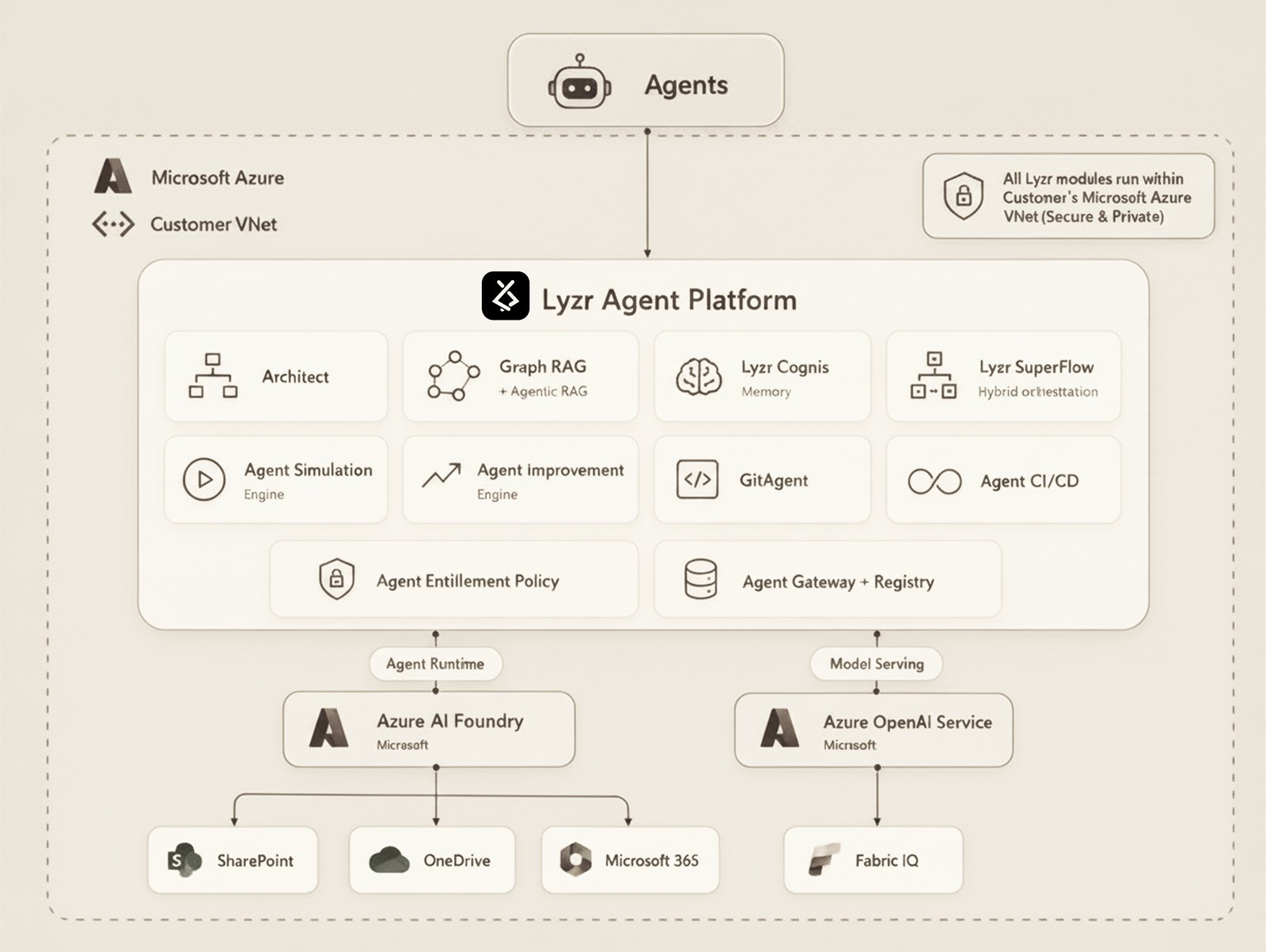
Lyzr reference architecture deployed inside HRDF infrastructure
Lyzr Agent Platform — deployed inside HRDF's infrastructure. Secure, private, no data egress.

On-prem, inside your perimeter

Kubernetes deployment within HRDF's own infrastructure. Works with Alibaba/SCCC, Grok, self-hosted models, or any provider. No cloud dependency. No data egress. Azure's Saudi Arabia East region extends this when available (Q4 2026) — no architecture changes required.

Built to SDAIA standards

Governance isn't a layer added later. The SDAIA AI Adoption Framework, NCA ECC/CCC controls, and PDPL requirements are built into how the platform operates — audit trails, entitlement policies, and human oversight are defaults, not configurations.

Your agents. Your IP. Your platform.

Every agent HRDF's team builds belongs to HRDF. Works with any model HRDF chooses to run — no lock-in to any single provider. Designed from day one to hand over. The goal from day one is for HRDF to run this without us.

The organisations that trust Lyzr look like HRDF.

Deploying AI inside a government perimeter — where data cannot leave, compliance is non-negotiable, and the stakes of a failed rollout are institutional — is a specific test. These are the organisations that have run it.

GOVERNMENT · SOVEREIGN DEPLOYMENT
US Government

Lyzr's largest customer by deployment scale. Data-private agents running on local models, zero external LLM data sharing — the identical deployment model HRDF requires.

GOVERNMENT · REGIONAL REFERENCE
A government workforce body in the region

Lyzr serves as the agentic control plane — the orchestration layer connecting the institution's data to its operational decisions.

Named on request. Not disclosed in written materials.
ENTERPRISE · REGULATED ENVIRONMENT
WTW (Willis Towers Watson)

A regulated enterprise in workforce analytics and advisory. In production on Lyzr's platform.

ACCENTURE'S INVESTMENT SIGNAL

$8M Series A (October 2025, Accenture Ventures) and $14.5M Series A+ led by Accenture (March 2026, valuation to $250M). The world's largest professional services firm has invested in Lyzr twice in five months. Accenture does not make back-to-back investments in infrastructure companies unless it is deploying them at scale with enterprise clients.

CB Insights AI 100 — 2026
Ranked #6 globally in "Infrastructure & Compute / Development & Deployment." 40,000+ companies assessed. As of May 2026.
Gartner
20 mentions across Gartner research in the twelve months to June 2026.
Source: Gartner Peer Insights and published research coverage.

Trust at this level isn't claimed. It's earned in environments where the constraints are identical — and the consequences of getting it wrong are real.

Four steps to first production agent. The only commitment this asks for is the conversation.

One conversation. One scoping document. That is all this asks for right now.

01
Architecture and deployment session
Lyzr's engineering team works through the deployment model with HRDF's infrastructure team — Kubernetes configuration, model connectivity, SDAIA compliance posture, data governance. The output is a confirmed architecture that both sides have agreed on before a line of code is written.
02
Use case prioritisation
One working session to confirm the Stage 01 POC anchor, define success metrics, and map data sources. Grant and Disbursement Intake Agent is the recommended starting point — subject to HRDF's own prioritisation.
03
POC scoping document
A concrete document: use case, deployment model, data sources, success metrics, timeline, and Stage 01 cost. Produced jointly. No surprises.
04
POC begins
Ninety days to a live agent inside HRDF's own systems, with HRDF's team having built it alongside Lyzr from day one. By the time Stage 01 is complete, the internal team is fluent on the platform and Stage 02 is already scoped.

HRDF holds the data behind Saudi Arabia's workforce.

Lyzr makes it compound.